

Delay
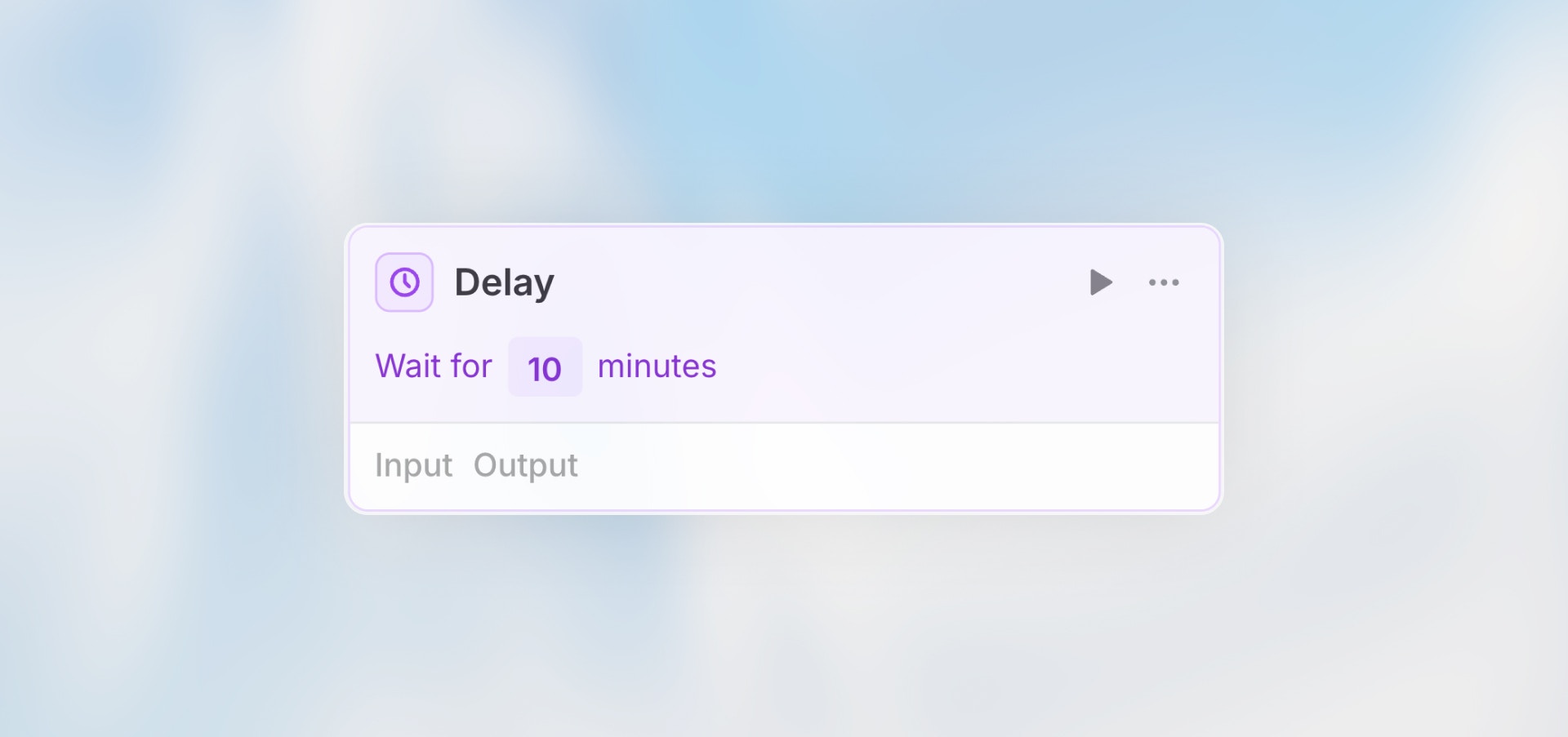
Overview
The Delay node pauses workflow execution for a specified duration. All subsequent nodes wait until the delay period completes before continuing. Perfect for polling, waiting for external processes, rate limiting, or implementing retry logic.
Best for: Polling APIs, waiting for processing, rate limiting, retry delays, and scheduled follow-ups.
Configuration
Delay Duration: Set the pause time between 1 second and 24 hours
Options:
Seconds (1-3600)
Minutes (1-1440)
Hours (1-24)
When to Use Delay
Perfect for:
Polling an API until a process completes
Waiting for external systems to process data
Rate limiting to avoid API throttling
Adding retry delays after errors
Scheduling follow-up actions
Implementing exponential backoff
Not ideal for:
Long-term scheduling (use Scheduled Trigger instead)
Delays longer than 24 hours
Time-based triggers (use Scheduled Trigger)
Example Use Cases
Retry with Backoff
Waiting for Processing
How It Works
Important: The delay is a real pause in execution. If you set a 1-hour delay, the workflow will literally wait 1 hour before continuing.
Use with Loops
Delays are especially useful inside loops to control execution rate:
Without delay: 100 API calls in ~10 seconds (may hit rate limits)
With 1-second delay: 100 API calls in ~100 seconds (stays under limits)
Limitations
Minimum delay: 1 second
Maximum delay: 24 hours
No cancellation: Once a delay starts, it cannot be interrupted
Workflow must stay active: The workflow continues running during the delay
Long delays keep the workflow execution running. For delays longer than a few hours, consider using a Scheduled Trigger to restart the workflow instead.
Cost Considerations
Delays themselves are free, but:
Workflow execution time includes the delay period
Long delays keep the workflow “running”
Consider if a scheduled workflow restart would be more efficient
Best Practices
Keep Delays Reasonable Long delays keep workflows running and can impact costs. Use Scheduled Triggers for delays over a few hours.
Consider Timeout Limits Workflows have execution time limits. Very long delays may cause the workflow to timeout.
Use Delays for Polling Smartly Start with shorter delays and increase gradually if needed. Don’t poll more frequently than necessary.
Document Why Delays Exist Add a comment to the delay node explaining why the pause is needed — your future self will thank you.